Change

Adapt, cope, remain flexible and foster a positive attitude amidst life's ups and downs.

Monday, October 21, 2019

Existential Crisis


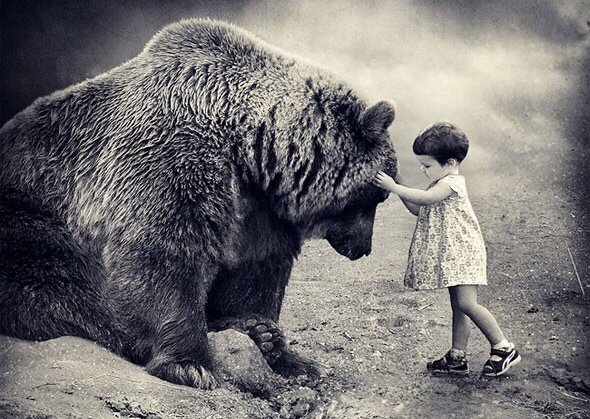
I love this photo because it tells it a story.   

image.png  

Existential Crisis
It is illogical to seek purpose or meaning in an uncaring world without purpose or meaning, or to accumulate excessive wealth in the face of certain death. Absurdity is used in existentialist and related philosophy to describe absurdly pointless efforts to try to find such meaning or purpose in an objective and uncaring world, a philosophy known as absurdism.

In his paper, The Absurd, Thomas Nagel analyzed the perpetual absurdity of human life. Absurdity in life becomes apparent when we realize the fact that we take our lives seriously, while simultaneously perceiving that there is a certain arbitrarity in everything we do. He suggests never to stop searching for the absurd. Furthermore, he suggests searching for irony amongst the absurdity.


The Absurd � Thomas Nagel  

In this selection, Nagel attempts to analyze a sentiment that is often expressed by those contemplating the meaning of life � namely, that �life is absurd.� He argues first that the reasons that are ordinarily given for thinking that life is absurd are inadequate. He maintains, though, that there is indeed a sense in which the human condition is absurd, and attempts to show why this is so. He further argues, though, that the absurdity of our lives need not be a source of distress for us.

It is sometimes suggested that the human condition is absurd because nothing we accomplish will matter in the distance future. But if this is so, Nagel maintains, then it must also be the case that facts about the distant future also do not matter now. But if that is right, then the fact that nothing I accomplish now will matter in the distant future is a fact that should not matter to me now. Thus, this is an insufficient reason for thinking that life is absurd. Nagel recognizes that people often rely on pointing out the brevity of a human life, and the relative minuteness of a human being in order to demonstrate that human lives are absurd. Again, though, Nagel thinks that these are considerations that are irrelevant to absurdity. He maintains that having infinitely long lives, or being infinitely large, would not diminish the absurdity. Next, he considers the argument that life is absurd because we cannot provide ultimate justification for our behavior in light of the fact that we will, at some point in the future, cease to exist. Nagel again rejects this reasoning; it is not the case that chains of justification need continue indefinitely.


In order to demonstrate that human life is indeed absurd, Nagel begins with a short analysis of how we ordinarily understand the concept. Absurdity results when there is a certain incongruity between the way the world actually is, and the �pretension or aspiration� of our dealings with the world. Absurdity concerning the human condition arises, then, when we attend to the fact that we take our lives extremely seriously, while simultaneously noting that there is a certain arbitrariness to everything that we do. Nagel then attempts to argue that we do indeed take our lives seriously, and secondly, that we are incapable of avoiding doubts about the importance or meaning of our lives. He notes several similarities that the argument for absurdity shares with arguments for epistemological skepticism. Just as skepticism, though, does not cast us into despair concerning our claims to knowledge, Nagel maintains that the absurdity of our lives should not be treated as a threatening problem. 


Little Child and a BIG BEAR


Image 

Little Girl Shows Courage  


Thursday, October 17, 2019

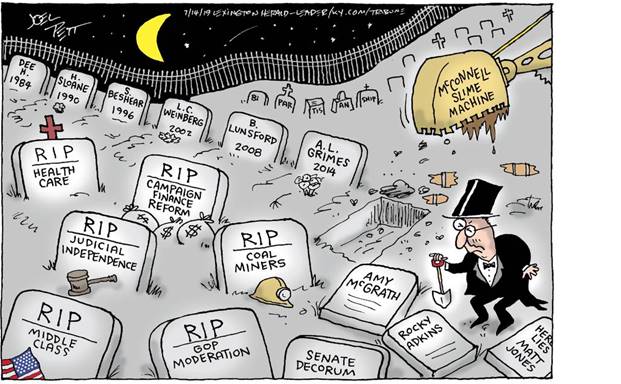
Moscow Mitch and his slime machine


Image

hitler doing the nazi salute


Adolf Hitler at the 1936 Berlin Olympics.
 Getty Images


A leading Holocaust historian just seriously compared the U.S. to Nazi Germany


“If the US has someone whom historians will look back on as the gravedigger of American democracy, it is Mitch McConnell.”


By Zack Beauchamp@zackbeauchampzack@vox.com

Oct 5, 2018


Usually, comparisons between Donald Trump America and Nazi Germany come from cranks and internet trolls. But a new essay in the New York Review of Books pointing out “troubling similarities” between the 1930s and today is different: It’s written by Christopher Browning, one of America’s most eminent and well-respected historians of the Holocaust. In it, he warns that democracy here is under serious threat, in the way that German democracy was prior to Hitler’s rise — and really could topple altogether.


Browning, a professor emeritus at the University of North Carolina, specializes in the origins and operation of Nazi genocide. His 1992 book Ordinary Men, a close examination of how an otherwise unremarkable German police battalion evolved into an instrument of mass slaughter, is widely seen as one of the defining works on how typical Germans became complicit in Nazi atrocities.


So when Browning makes comparisons between the rise of Hitler and our current historical period, this isn’t some keyboard warrior spouting off. It is one of the most knowledgeable people on Nazism alive using his expertise to sound the alarm as to what he sees as an existential threat to American democracy.


Browning’s essay covers many topics, ranging from Trump’s “America First” foreign policy — a phrase most closely associated with a group of prewar American Nazi sympathizers — to the role of Fox News as a kind of privatized state propaganda office. But the most interesting part of his argument is the comparison between Senate Majority Leader Mitch McConnell and Paul von Hindenburg, the German leader who ultimately handed power over to Hitler. Here’s how Browning summarizes the history:


Paul von Hindenburg, elected president of Germany in 1925, was endowed by the Weimar Constitution with various emergency powers to defend German democracy should it be in dire peril. Instead of defending it, Hindenburg became its gravedigger, using these powers first to destroy democratic norms and then to ally with the Nazis to replace parliamentary government with authoritarian rule. Hindenburg began using his emergency powers in 1930, appointing a sequence of chancellors who ruled by decree rather than through parliamentary majorities, which had become increasingly impossible to obtain as a result of the Great Depression and the hyperpolarization of German politics.


Because an ever-shrinking base of support for traditional conservatism made it impossible to carry out their authoritarian revision of the constitution, Hindenburg and the old right ultimately made their deal with Hitler and installed him as chancellor. Thinking that they could ultimately control Hitler while enjoying the benefits of his popular support, the conservatives were initially gratified by the fulfillment of their agenda: intensified rearmament, the outlawing of the Communist Party, the suspension first of freedom of speech, the press, and assembly and then of parliamentary government itself, a purge of the civil service, and the abolition of independent labor unions. Needless to say, the Nazis then proceeded far beyond the goals they shared with their conservative allies, who were powerless to hinder them in any significant way.


McConnell, in Browning’s eyes, is doing something similar — taking whatever actions he can to attain power, including breaking the system for judicial nominations (cough cough, Merrick Garland) and empowering a dangerous demagogue under the delusion that he can be fully controlled:


If the US has someone whom historians will look back on as the gravedigger of American democracy, it is Mitch McConnell. He stoked the hyperpolarization of American politics to make the Obama presidency as dysfunctional and paralyzed as he possibly could. As with parliamentary gridlock in Weimar, congressional gridlock in the US has diminished respect for democratic norms, allowing McConnell to trample them even more. Nowhere is this vicious circle clearer than in the obliteration of traditional precedents concerning judicial appointments. Systematic obstruction of nominations in Obama’s first term provoked Democrats to scrap the filibuster for all but Supreme Court nominations. Then McConnell’s unprecedented blocking of the Merrick Garland nomination required him in turn to scrap the filibuster for Supreme Court nominations in order to complete the “steal” of Antonin Scalia’s seat and confirm Neil Gorsuch. The extreme politicization of the judicial nomination process is once again on display in the current Kavanaugh hearings. ...


Whatever secret reservations McConnell and other traditional Republican leaders have about Trump’s character, governing style, and possible criminality, they openly rejoice in the payoff they have received from their alliance with him and his base: huge tax cuts for the wealthy, financial and environmental deregulation, the nominations of two conservative Supreme Court justices (so far) and a host of other conservative judicial appointments, and a significant reduction in government-sponsored health care (though not yet the total abolition of Obamacare they hope for). Like Hitler’s conservative allies, McConnell and the Republicans have prided themselves on the early returns on their investment in Trump.


This is the key point that people often miss when talking about Hitler’s rise. The breakdown of German democracy started well before Hitler: Hyperpolarization led Hindenburg to strip away constraints on executive power as well as conclude that his left-wing opponents were a greater threat than fascism. The result, then, was a degradation of the everyday practice of democracy, to the point where the system was vulnerable to a Hitler-style figure.


Now, as Browning points out, “Trump is not Hitler and Trumpism is not Nazism.” The biggest and most important difference is that Hitler was an open and ideological opponent of the idea of democracy, whereas neither Trump nor the GOP wants to abolish elections.


What Browning worries about, instead, is a slow and quiet breakdown of American democracy — something more much like what you see in modern failed democracies like Turkey. Browning worries that Republicans have grown comfortable enough manipulating the rules of the democratic game to their advantage, with things like voter ID laws and gerrymandering, that they might go even further even after Trump is gone:


No matter how and when the Trump presidency ends, the specter of illiberalism will continue to haunt American politics. A highly politicized judiciary will remain, in which close Supreme Court decisions will be viewed by many as of dubious legitimacy, and future judicial appointments will be fiercely contested. The racial division, cultural conflict, and political polarization Trump has encouraged and intensified will be difficult to heal. Gerrymandering, voter suppression, and uncontrolled campaign spending will continue to result in elections skewed in an unrepresentative and undemocratic direction. Growing income disparity will be extremely difficult to halt, much less reverse.


I’ve observed this kind of modern authoritarianism firsthand in Hungary. In my dispatch after visiting there, I warned of the same thing as Browning does here: The threat to the United States isn’t so much Trump alone as it is the breakdown in the practice of American democracy, and the Republican Party’s commitment to extreme tactics in pursuit of its policy goals in particular.


We are living through a period of serious threat to American democracy. And Browning’s essay, a serious piece by a serious scholar, shows that it’s not at all alarmist to say so.


Link: https://www.vox.com/policy-and-politics/2018/10/5/17940610/trump-hitler-history-historian


How to evaluate information, from social media to scholarly articles.


Sheridan Libraries
Guides
Evaluating Information
Evaluating Social Media

How to evaluate information, from social media to scholarly articles.


Home
Evaluating Sources
Evaluating Internet Resources
Evaluating Social Media
Propaganda vs. Misinformation
Peer ReviewToggle Dropdown

Fake News and Your Brain


How Fake News Tricks your Brain

Accuracy Checklist


Social media can provide instant news faster than traditional news outlets or sources and can be a great wealth of information, but there is also an ever increasing need to verify and determine accuracy of this information. Here are some items to consider that can help determine authenticity:
Location of the source - are they in the place they are tweeting or posting about?

Network - who is in their network and who follows them? Do I know this account?

Content - Can the information be corroborated from other sources?

Contextual updates - Do they usually post or tweet on this topic? If so, what did past or updated posts say? Do they fill in more details?

Age - What is the age of the account in question? Be wary of recently created accounts.
Reliability - Is the source of information reliable?

Tips for Citing Social Media


Check the manuals for your style guide for the most up-to-date information. If your style guide doesn't cover it in print, then look to their online website to see if they've included some information there on proper citation for these social media formats. Also try our citing guide for more information or email your librarian.

APA Suggestions for citing twitter on Face Book

Introduction


According to Twitter, the site has more than 140 million active users, with over 340 million Tweets per day. This means that one billion tweets are sent every three days. More and more people get news and information from news media, but it's important to remember that fast does not always mean accurate.

How to identify credible information on social media can be challenging. Rumors and misinformation can spread quickly through social media outlets such as Twitter or Facebook. Some of the criteria used to evaluate Internet sources, such as being skeptical, asking questions, looking at the quality of the source of the information, still apply in social media. At the same time, a new and quicker way to exchange information, without some of the clues of authorship provided by more traditional online sources, means we can add some new techniques and approaches to evaluating information.

Storyful recently added four case studies that show how they verified online videos and other content for clients. From their blog:

"At Storyful, we interrogate content shared on the social web in a style not dissimilar Barber’s grilling of dignitaries of media and politics. We adopt a natural skepticism to every item of content we discover. Verification is a cornerstone of our work and it has to be. Information and content often spreads across social media in ‘Chinese whispers’ fashion. Videos and images are spliced, diced and re-posted. Context and details change, agendas compete. Falsehoods and fabrications are deliberately issued.

Within an hour of the Pacific tsunami alert being issued on April 11, 2012, Twitter and YouTube abounded with videos purporting to show monster waves striking the coast of Sumatra and Aceh in Indonesia. However, these were versions of the devastating 2004 tsunami and other dramatic videos, reissued with the 2012 date. In December 2011, when a police officer was killed at Virginia Tech in the US, a picture of the 2007 massacre was widely circulated as the 2011 event. In both instances, Storyful was quickly able to debunk this content as false."


Verifying information is important regardless of the type of social media outlet. Twitter is not immune to fake accounts. Recently, a manager from Google created a bot that attracted followers on Twitter. When the bot posted about a running injury, followers expressed concern over her injury. Wired initially reported on this story and it seems that the bot account has since been suspended. In an experiment conducted late last year, researchers created nine Twitter bots that were able to attract, on average, 62 followers each over a three-week period. This rise in the use of bots raises questions about how easy it might be for someone to try to influence news via social media outlets.

If you are unsure whether a social media post is from a person or bot, do not use the source.

Verifying Information from Social Media

Paul Bradshaw, a leading digital media expert and teacher in Europe, writes the Online Journalism Blog. In 2011, he wrote a post that provides a variety of basic guidelines about online verification with a section related to social media:

How long has the account existed? If it’s only existed since a relevant story broke (e.g. Jan Moir’s column; an earthquake where someone claims to be a witness) then it’s likely to be opportunistic.

Who did the person first ‘follow’ or ‘friend’? These should be personal contacts, or fit the type of person you’re dealing with. If their first follow is ReadWriteWeb, then it may be that you’re not actually dealing with a Daily Mail columnist.


Who first followed them? Likewise, it should be their friends and colleagues.


Who has spoken to them online? Ditto.


Who has spoken about them? Here you may find friends and colleagues, but also people who have rumbled them. But don’t take anyone else’s word for their existence unless you can verify them too.


Can you correlate this account with others? The Firefox extension Identify is a useful tool here: it suggests related social network accounts which you can then try to cross-reference. For companies the Chrome extension Polaris Insights does something similar for companies.


Wednesday, October 16, 2019

Checklist for social media:


Accuracy and accountability checklist for social media:

Way back in the early fall, when the Online News Association conference was going on here in D.C., Craig Silverman of Regret the Error did a greataccuracy workshop in conjunction with TBD. He created an accuracy checklist aimed at helping reporters avoid common errors. My boss, Steve Buttry,expanded on Silverman’s list at his own blog a couple of weeks ago. This checklist approach inspired me to think of ways to avoid accuracy and reporting errors in my own little corner of the journalism world.

In the rapid-fire world of social media, it’s easy for a journalist or news organization to make mistakes. Sometimes, these things happen in the heat of the moment, but more often than not the errors seem to stem from a widespread belief amongst journalists that Twitter carries less need for accuracy and accountability than the full-story medium.

 Recent events have told us otherwise

I believe there is an ever-increasing need for accuracy and accountability in how we as journalists use social media. This inspired me to start my own accuracy checklist for the TBD staff, but I thought it may be better to share with a larger audience. Feel free to add your notes and additions in the comments. I consider this a work in progress.

Accuracy Checklist for Social Media

Before tweeting:
  • How do I know this information?
  • Is this information independently confirmed? Should it be first?
  • Do I know the location of the news event? Check a map.
  • Will this require follow-up tweets to better explain? Do I know this story well enough to follow-up?


When tweeting:
  • Are proper names spelled correctly?
  • Does the link go to the right place? Is it shortened properly?
  • Are any Twitter handles included? Do they go to the right accounts?
  • Does this tweet have/need attribution for reported facts?
  • Does this tweet need a hat tip for another Twitter account/news outlet who first alerted you to the info?
  • Is a location included/necessary?
  • Is this tweet short enough to be easily re-tweeted?
  • Check to see if auto-correct changed the text intended.
  • Check your shorthand and contractions to make sure they make sense.

When re-tweeting:
  • Is it clear why I want to share this tweet, or does it need context?
  • Is this tweet reporting heretofore unknown information?
  • If so, is this source reliable enough to throw your name behind?
  • Is the original tweet written clearly enough to be passed on from me?

When sharing on Facebook:
  • Is the image that shows up in my link preview actually connected to the story?
  • Is the post text and headline reflective of the content of the story?
  • Are any tagged users in images/posts the correct people?

What’s missing here? Let me know. eventually, I’ll make this look spiffy and get it online as a lovely printable document. 


http://zombiejournalism.com/2011/01/accuracy-and-accountability-checklist-for-social-media/trackback/


http://zombiejournalism.com/2011/01/accuracy-and-accountability-checklist-for-social-media/


Wednesday, September 18, 2019

Yuval Harari: "Techno-Religions and Silicon Prophets" | Talks at Google


Yuval Harari: "Techno-Religions and Silicon 
Prophets" | Talks at Google 


Techno-Religions and Silicon Prophets: 

Will the 21st century be shaped by hi-tech gurus or by religious zealots – or are they the same thing?

What is the current status of religions and ideologies in the world, and what will be the likely impact of 21st-century technological breakthroughs on religion and ideology? 

Will traditional religions and ideologies—from Christianity and Islam to Liberalism and Socialism—manage to survive the technological and economic revolutions of the 21st century?

What would be the place of Islam, for example, in a world of genetic engineering and artificial intelligence? 

The talk addresses these questions, and argues that the future belongs to techno-religions, which promise salvation through technology, and which are already gathering believers in places such as Silicon Valley.


Link:


About the Author
 

Prof. Yuval Noah Harari lectures at the Department of History, the Hebrew University of Jerusalem. 

He specializes in World History, medieval history and military history. 

His current research focuses on macro-historical questions: 

What is the relation between history and biology? 

Is there justice in history? 

Did people become happier as history unfolded? 

His most recent book is Sapiens: A Brief History of Humankind. 

The book surveys the entire length of human history, from the evolution of Homo sapiens in the Stone Age up to the political and technological revolutions of the Silicon Age. 

It has become an international bestseller, and has been translated into close to 30 languages worldwide. 

For more details see www.ynharari.com


Saturday, August 24, 2019

Introspection


He looked at his own Soul
with a Telescope.  What seemed 
all irregular, he saw and 
shewed to be beautiful
Constellations; and he added 
to the Consciousness hidden
worlds within worlds.

Coleridge, Notebooks

Wednesday, August 21, 2019

TOP 20 Arthur Rubinstein Quotes


Kathleen Battle - Villa-Lobos: Bachianas Brasileires No. 5


Kathleen Battle - Villa-Lobos: Bachianas Brasileires No. 5

Kathleen Battle 1st movement of Villa-Lobos Bachianas Brasileires no. 5 concertoes for voice and eight cellists.
From "Gala of the Stars 1985"


Barnes Lecture 2019 - Jon Kabat-Zinn


In his talk, "The Public Health Roots of Mindfulness-Based Stress Reduction," Dr. Jon Kabat-Zinn described the core elements of MBSR, its roots in public health, and some of the lines of evidence supporting its clinical effectiveness across a wide range of medical conditions and diagnoses.

Brown University
Wednesday, April 3, 2019


Mindfulness as a Love Affair with Life: An Interview with Jon Kabat-Zinn


Mindfulness as a Love Affair with Life: An Interview with Jon Kabat-Zinn


Jon Kabat-Zinn - Where Is This All Going, and What’s Love Got to Do With...


Lovers - Kathleen Battle.


Lovers - Kathleen Battle.

This song is used at the end of the movie, House of Flying Daggers.

Composer - Shigeru Umebayashi
Singer- Kathleen Battle

~Lyrics:~

There was a field in my old town
Where we always played hand in hand
The wind was gently touching the grass
We were so young, so fearless.

Then I dreamt o'er and over,
Of you holding me tight under the stars
I made a promise to my dear lord,
I will love you forever

Time has passed
So much has changed
But the field remains in my heart
Oh, where are you?
I need to tell you I still love you
So I reach out for you,
You fly around me like a butterfly.
Your voice still echoes in my heart,
You are my true love.

There was a field in my old town,
Where in spring all flowers blossomed wide.
We were chasing butterflies
Hand in hand till close of day.
Your voice still echoes in my heart.


Kathleen BATTLE - Videoclips from Japan


Kathleen Battle sings
- Del Cabello más sutil (Obradors)
- Plaisir d'amour (Martini)
- Ombra mai fù (Händel)