The greatest revolution of our generation is the discovery that human beings by changing the inner attitudes of their minds can change the outer aspects of their lives.
-- William James
“Your body does not eliminate poisons by knowing their names. To try
to control fear or depression or boredom by calling them names is to
resort to superstition of trust in curses and invocations. It is so easy
to see why this does not work. Obviously, we try to know, name, and
define fear in order to make it “objective,” that is, separate from
“I.””
“This is the real secret of life – to be completely engaged with what
you are doing in the here and now. And instead of calling it work,
realize it is play.”
“The art of living… is neither careless drifting on the one hand nor
fearful clinging to the past on the other. It consists in being
sensitive to each moment, in regarding it as utterly new and unique, in
having the mind open and wholly receptive.”
“We are living in a culture entirely hypnotized by the illusion of
time, in which the so-called present moment is felt as nothing but an
infintesimal hairline between an all-powerfully causative past and an
absorbingly important future. We have no present. Our consciousness is
almost completely preoccupied with memory and expectation. We do not
realize that there never was, is, nor will be any other experience than
present experience. We are therefore out of touch with reality. We
confuse the world as talked about, described, and measured with the
world which actually is. We are sick with a fascination for the useful
tools of names and numbers, of symbols, signs, conceptions and ideas.”
“No valid plans for the future can be made by those who have no capacity for living now.”
“Muddy water is best cleared by leaving it alone.”
“I have realized that the past and future are real illusions, that
they exist in the present, which is what there is and all there is.”
“…tomorrow and plans for tomorrow can have no significance at all
unless you are in full contact with the reality of the present, since it
is in the present and only in the present that you live.”
“The meaning of life is just to be alive. It is so plain and so
obvious and so simple. And yet, everybody rushes around in a great panic
as if it were necessary to achieve something beyond themselves.”
“To have faith is to trust yourself to the water. When you swim you
don’t grab hold of the water, because if you do you will sink and drown.
Instead you relax, and float.”
“Advice? I don’t have advice. Stop aspiring and start writing. If
you’re writing, you’re a writer. Write like you’re a goddamn death row
inmate and the governor is out of the country and there’s no chance for a
pardon. Write like you’re clinging to the edge of a cliff, white
knuckles, on your last breath, and you’ve got just one last thing to
say, like you’re a bird flying over us and you can see everything, and
please, for God’s sake, tell us something that will save us from
ourselves. Take a deep breath and tell us your deepest, darkest secret,
so we can wipe our brow and know that we’re not alone. Write like you
have a message from the king. Or don’t. Who knows, maybe you’re one of
the lucky ones who doesn’t have to.”
On Change
“The more a thing tends to be permanent, the more it tends to be lifeless.”
“The only way to make sense out of change is to plunge into it, move with it, and join the dance.”
“You and I are all as much continuous with the physical universe as a wave is continuous with the ocean.”
“No one is more dangerously insane than one who is sane all the time:
he is like a steel bridge without flexibility, and the order of his
life is rigid and brittle.”
“Without birth and death, and without the perpetual transmutation of
all the forms of life, the world would be static, rhythm-less,
undancing, mummified.”
“Never pretend to a love which you do not actually feel, for love is not ours to command.”
“What I am really saying is that you don’t need to do anything,
because if you see yourself in the correct way, you are all as much
extraordinary phenomenon of nature as trees, clouds, the patterns in
running water, the flickering of fire, the arrangement of the stars, and
the form of a galaxy. You are all just like that, and there is nothing
wrong with you at all.”
“Trying to define yourself is like trying to bite your own teeth.”
“But I’ll tell you what hermits realize. If you go off into a far,
far forest and get very quiet, you’ll come to understand that you’re
connected with everything.”
“The source of all light is in the eye.”
“Technology is destructive only in the hands of people who do not
realize that they are one and the same process as the universe.”
On the Universe
“We do not “come into” this world; we come out of it, as leaves from a tree.”
“Only words and conventions can isolate us from the entirely undefinable something which is everything.”
“But I’ll tell you what hermits realize. If you go off into a far,
far forest and get very quiet, you’ll come to understand that you’re
connected with everything.”
“You are an aperture through which the universe is looking at and exploring itself.”
On Problems
“Problems that remain persistently insoluble should always be suspected as questions asked in the wrong way.
On Zen
“Zen does not confuse spirituality with thinking about God while one
is peeling potatoes. Zen spirituality is just to peel the potatoes.”
Who are you really? An amazing lecture given by Alan Watts a British philosopher, writer, and speaker. Speech extract from "Does it do you, or do you do it" by Alan Watts, courtesy
Self Discipline, Loyalty, Work, Responsibility. Courage. Compassion. Honesty. Friendship. Perseverance.
Faith.Everyone recognizes these traits as essentials of good character.
In order for our children to develop such traits, we have to offer them
examples of good and bad, right and wrong. And the best places to find
them are in great works of literature and exemplary stories from
history.
William J. Bennett has collected hundreds of stories in The Book of Virtues,
an instructive and inspiring anthology that will help children
understand and develop character -- and help adults teach them.
From the
Bible to American history, from Greek mythology to English poetry, from
fairy tales to modern fiction, these stories are a rich mine of moral
literacy, a reliable moral reference point that will help anchor our
children and ourselves in our culture, our history, and our traditions
-- the sources of the ideals by which we wish to live our lives.
Complete with instructive introductions and notes, The Book of Virtues is a book the whole family can read and enjoy -- and learn from -- together.
---------- Forwarded message ---------- From: Mark Arce Date: Tue, Jan 10, 2017 at 1:22 PM Subject: Expert Source Available - Indian Point Closure To: Mark Arce
Source Available
Topic:
Indian Point Closure
Source:
Richard Riley is the North America Business Development Manager for Highview Power Storage, and based at
New York City’s hub for smart cities, smart grid, and clean energy at the NYU Tandon School of Engineering, ACRE.
A mechanical engineer by training,
Richard began his career with French utility EDF in the construction and maintenance of power generation assets.
He joined Highview in 2013 to support the development of Liquid Air Energy Storage systems, including the engineering and construction of the company’s
5 MW demonstrator in the north of England.
Richard
is a Chartered Engineer, Member of the UK’s Institute of Mechanical
Engineers and alumnus of the Royal Academy of Engineering’s Engineering
Leadership Award program.
Richard Riley
can comment on:
·Indian Point closure announcement
·NYC/NYS clean energy economy
·Expertise on running a cleantech company
Contact:
Please direct media inquiries to
Jordan Isenstadt of MarinoPR at
JIsenstadt@marinopr.com
About Highview
Highview Power Storage is a designer and developer of large-scale energy storage solutions for
utility and distributed power systemsthat
use liquid air as the storage medium. Highview can design bespoke
Liquid Air Energy Storage (LAES) plants that can deliver from 5MW/15MWh –
to more than 200MW/1.2GWh to service a growing
multi-billion dollar energy storage market. LAES has been developed
using proven components from industry to deliver a pumped-hydro
capability without geographical constraints, and can be configured to
convert waste heat and cold to power.
At
the end of 2013 Highview signed a global licencing and technology
collaboration agreement, with GE Oil & Gas, to develop the
integration of Highview’s LAES technology into its peaker plant
offering.
“Our actions may be impeded… but there can be no impeding our
intentions or dispositions. Because we can accommodate and adapt. The
mind adapts and converts to its own purposes the obstacle to our
acting.”– Marcus Aurelius
I believe that the denizens of the Renaissance, Industrial Revolution, or Great Depression felt that the rate of change in their lives was unprecedented. In my lifetime I feel that we are currently undergoing change at an unprecedented rate. The fundamental ways businesses operate, communicate internally and externally and even monetize products and services seems subject to constant redefinition. Where once Microsoft and its predecessors were the corporate standard, the new standards are still being defined, and that uncertainty is throwing much of the norms of the corporate world into disarray.
Take email, until fairly recently, the standard means of corporate written communication; now a bane of the office worker’s existence. What method do you use to communicate with your colleagues and customers? We are using Slack and text messages for internal communications, and a combination of email, dashboards, chats and forums for communicating with our clients based on their preference.
Six months ago that was not the case and in six months my answer will change. Email is a fairly benign example. The rapid pace and breadth of innovation is changing
every aspect of business.
Source: Harvard Business Review
With the advent of lean startups and other approaches to
drastically reducing time to market, competitive landscapes are changing
almost overnight. We were working with a client to develop a novel
product in the transportation sector. By the time we were ready to
launch, under a fairly rapid development lifecycle for this client
(months instead of years), there were three competitors who stripped us
of the first mover advantage. When we began the project those
competitors were nonexistent.
Recently, much of the work we are engaged in revolves
around helping transform organizations to better respond to this new
world order where change is the only constant and speed/innovation is
less of a competitive advantage and more a cost of doing business.
There is a plethora of frameworks, methodologies and approaches to
build the necessary capabilities to compete in our current global
environment. You’ve likely heard of, used or are using a methodology
like SCRUM or XP (SAFe, LeSS or DAD if you need to scale) or the
aforementioned lean startup approach. The approach we use at Certus is
called Adaptive Execution which is based on many of the same principles,
with a twist. In addition to a focus on people, process, technology and
communication, we focus on positivity and reframing interactions.
Regardless of chosen methodology, a change in some aspect of your
organization’s day to day operations will be required. The generally
accepted approach to driving change in a culture was codified by Dr.
John Kotter. A brief overview of his model can be viewed here:
The specifics of implementing change vary dramatically from one
organization to another. What works in one culture may completely
backfire in another, and that is what makes change management part art
and part science. Generally, where we find the greatest success in
facilitating change are situations where:
1. There is a clear and present need:
Organizations that are experiencing a downturn, be it in market
share, revenue growth, profitability or some other key metric are more
open to reassessing how they operate. The more public and well
articulated the pain, the more pressing the agenda for change.
2. We have the support of at least one key executive:
While I am a firm believer in the power of grassroots approaches, in
today’s organizations where fewer people are doing more work, it is
challenging to organize people in a short time frame without an
executive sponsoring the initiative.
3. There is an opportunity to pilot the approach on an impactful initiative:
A carefully selected pilot project that minimizes the overall
organizational risk, but has a quantifiable impact can have a profound
impact and intrigue enough people in the organization. This also gives
the working team an opportunity to tailor the approach to their culture
and way of operating before it spreads. Ultimately, there should be a
demonstration of value in adopting a new approach.
Furthermore, the
impact needs to be noteworthy (think 10x or greater). Recently we
employed a pilot to restart a stalled initiative which rallied people
and brought renewed energy and focus on the project.\
4. The organization understands that the approach is a means to an end:
Whatever methodology or hybrid methodology your organization selects,
that is only the beginning. The goal of any new way of working is to
simplify the delivery of value to your customers. No approach is a
panacea. It will need to be broken and experimented with repeatedly and
it will still need to evolve with your organization, customers and
competitors. Being adaptive means constant reassessment and revision. A
few weeks ago, This American Life aired a repeat of an episode about the
NUMMI venture between General Motors and Toyota.
Storytelling in the corporate world is seeing a renaissance.
Articulating your voyage, and painting a picture of the art of the
possible is increasingly being expected and is a differentiator in an
otherwise crowded sea of initiatives.
The hallmark of all these approaches is discovering and doing more of
what your customers value, faster. That spirit is embodied in the
principles of Lean manufacturing, which has been a driving force in
reshaping entire industries. If you think of the factory owner as the
customer and maximizing throughput as the goal, it can also be found in
elements of mass production. At the start of this piece I referenced the
industrial revolution and other periods of great innovation and change.
Perhaps we are not so different in the way we work from our ancestors?
Regardless of industry, there seems to be a common way to work today.
The goal is weaving together the most appropriate elements to deliver
the most value to your customers in the shortest time with minimum
effort.
In parting, while the world has changed and continues to change, I
believe our only recourse is to adapt. I think that advice is timeless,
but particularly timely today.
http://www.ted.com
Our medical systems are broken. Doctors are capable of extraordinary
(and expensive) treatments, but they are losing their core focus:
actually treating people. Doctor and writer Atul Gawande suggests we
take a step back and look at new ways to do medicine -- with fewer
cowboys and more pit crews.
A seed is destroyed in the process of being a plant. We have to be willing to #change our old identity to transform into a new being. ..
#quotes#inspiration
Despite
access to more customer information than ever before product messages are
clicking less often with customers. The inescapable truth is we know less about
customers than we should, given the $6 billion a year companies spend trying to
figure out what makes them tick.
Bill Bernbach, one of
advertising’s greatest minds, would understand the problem:
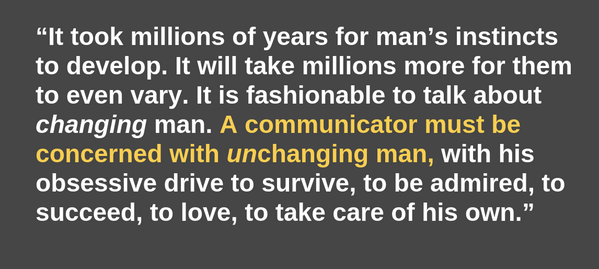
“Human nature hasn’t changed for a million years. It won’t even
change in the next million years. Only the superficial things have changed. It
is fashionable to talk about the changing man. A communicator must be
concerned with the unchanging man – what compulsions drive him, what
instincts dominate his every action, even though his language too often
camouflages what really motivates him.”
Bernbach
was not a psychologist, but had an uncanny intuitive grasp of human behavior.
While most of us may lack the intuitive competence of Bernbach, we can get to
know our customers better by acquiring a deeper understanding of unchanging
man. But we cannot get that understanding through traditional customer
research.
Renown brain
scientist Richard Restak has observed that"We
have reason to doubt that full awareness of our motives, drives, and other
mental activities may be possible." Cognitive scientists tell us that with
the aid of new brain canning technology, they’ve learned that about 95 percent
of the mental activity going into our decision-making takes place behind the
curtains of consciousness. Yet, most consumer research concentrates exclusively
on the contents of consumers’ conscious minds.
The roots of motivations lie beyond the knowing reach of
our conscious minds. When people tell researchers’ why they do what they do,
they can only speak to what appears on the screens of their conscious minds.
Those images are often at odds with their more primal sources of motivations.
Marketing
mostly ignores the silent 95 percent zone in the brain.Why?The
“superficial things” that show up in the conscious mind are more visible,
measurable and quantifiable. Companies feel more comfortable with the
measurable, so they spend vast sums researching customers’ superficial
attributes. Procter and Gamble alone conducts 4,000 to 5,000 customer studies
a year.
It’s harder to quantify “what compulsions
drive customers, what instincts dominate their every action.” To fathom the unchanging
man requires understanding behavior at its roots in human biology.
Ever
wonder how cravings develop? Be they for sex or chocolate, they are not
consciously created. It’s 3:30 PM. Your energy is sagging. A small organ over
your kidneys senses a sugar shortage and sets off a flow of neuropeptide Y
to alert your brain of a need for carbs. The plea reaches your conscious mind
as a craving for chocolate. You ponder whether to stick to your diet or give
in, then say to yourself, “What the hell,” pop a piece of Godiva in your mouth
and resolve to eat salad for dinner. You enjoy the moment by giving into the
craving.
While
you exercised free will (hopefully!) in reacting to the craving, the action you
took had its roots in your biology. So it is with behavior in general.
The email from the boy began: “Did anything inspire you
to create Hallelujah?"
Later that same winter day the reply arrived:
“I wanted to stand with those who clearly see God’s holy broken world
for what it is, and still find the courage or the heart to praise it.
You don’t always get what you want. You’re not always up for the
challenge. But in this case — it was given to me. For which I am deeply
grateful.”
The
question came from the author's son, who was preparing to present the hymn to his fifth-grade class. The boy required a
clarification about its meaning. The answer came from the author of the
song, Leonard Cohen.
Cohen lived in a weather of wisdom, which he created by seeking it rather
than by finding it. He swam in beauty, because in its transience he
aspired to discern a glimpse of eternity.
There was always a trace of
philosophy in his sensuality.
He managed to combine a sense of absurdity
with a sense of significance, a genuine feat.
He was a friend
of melancholy but an enemy of gloom, and a
renegade enamored of tradition.
Leonard
was, above all, in his music and in his poems and in his tone of life,
the lyrical advocate of the finite and the flawed.
Leonard
sang always as a sinner. He refused to describe sin as a failure or a
disqualification. Sin was a condition of life.
“Even though it all went wrong/
I’ll stand before the Lord of song/ With nothing on my tongue but
Hallelujah!”
The
singer’s faults do not expel him from the divine presence. Instead they
confer a mortal integrity upon his exclamation of praise.
He is the
inadequate man, the lowly man, the hurt man who has given hurt,
insisting modestly but stubbornly upon his right to a sacred exaltation.
“There is a crack in everything. That’s how the light gets in.”
He once
told an interviewer that those words were the closest he came to a
credo.
The teaching could not be more plain: fix the crack, lose the
light.
Here is a passage on frivolity by a great rabbi
in Prague at the end of the 16th century:
“Man was born for toil, since
his perfection is always being actualized but is never actual,” he
observed in an essay on frivolity. “And insofar as he attains
perfection, something is missing in him. In
such a being, perfection is a shortcoming and a lack.”
Leonard Cohen
was the poet laureate of the lack, the psalmist of the privation, who
made imperfection gorgeous.