The No. 1 Lifelong Habit Of Warren Buffett: The 5-Hour Rule
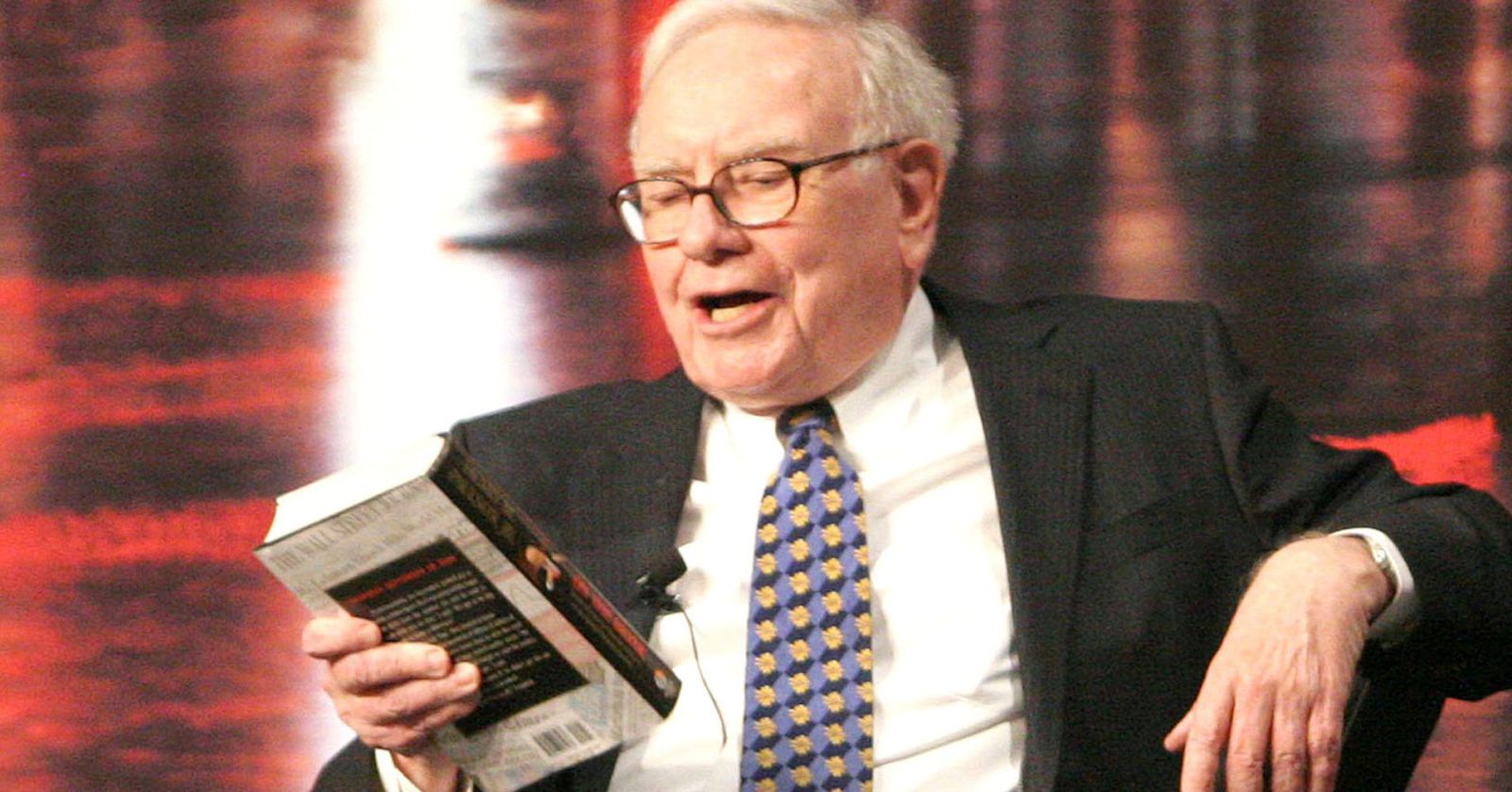
I remember the first time I heard that Warren Buffett spends 80 percent of his time reading and thinking, and has done so for his entire career.
I was even more surprised by how Buffett’s long-term business partner describes his weekly schedule:
You look at his schedule sometimes and there’s a haircut.
Tuesday, haircut day.
That’s what created one of the world’s most successful business records in history. He has a lot of time to think.
“WTF?!” I thought myself. “That makes no sense.”
“How can the CEO of a company with hundreds of thousands of employees have so much free time while my schedule is packed?”
“What is the smartest investor in history seeing that I’m not?” I wondered.
After
years of watching nearly every Buffett interview, reading his annual
Letters to Shareholders, reading multiple biographies, and applying the
lessons to my life, I think I finally have the answer to why and how
Buffett has adopted this schedule.
This article shares that answer.
By the end of it, you’ll have a clear path to adopting the 5-Hour Rule
(deliberately learning for at least five hours per week) and moving
much closer to Buffett’s more intensive Learner’s Lifestyle (making
deliberate learning your No. 1 competitive advantage and getting
essentially paid to learn).
But, first, let’s uncover what Buffett sees about knowledge work that most of us don’t.
The Case For The Learner’s Lifestyle
In short, all that Buffett research made me realize two things…
First, in a knowledge economy, learning and thinking are the single best long-term investments you can make in your career. Learning and thinking determine our decisions. Then, decisions determine our results.
Second, Buffett’s schedule is a harbinger of a new class of knowledge workers (especially investors, entrepreneurs, designers, developers, coaches, consultants, thought leaders, etc.) who realize that learning and thinking, not just doing, are the keys to their long-term success.
Let’s go a level deeper.
In 2009, Paul Graham, wrote an iconic article called Maker’s Schedule, Manager’s Schedule.
Graham is the founder of YCombinator, the most successful startup accelerator in history — backer of AirBnb, Dropbox, Stripe, and Reddit.
In the article, he spells out the difference between two types of schedules in a knowledge economy:
Manager Schedule: The manager’s schedule is for bosses. It’s embodied in the traditional appointment book, with each day cut into one-hour intervals. You can block off several hours for a single task if you need to, but by default you change what you’re doing every hour.
Maker’s Schedule: But there’s another way of using time that’s common among people who make things, like programmers and writers. They generally prefer to use time in units of half a day at least. You can’t write or program well in units of an hour. That’s barely enough time to get started.
Buffett’s contribution is a third category — the Learner’s Lifestyle.
In short, The Learner’s Lifestyle optimizes for insight over coordination and output. Whereas
the manager’s schedule is primarily about coordination and the maker’s
schedule is about output, the Learner’s Lifestyle is primarily about
insight.

This distinction is simple yet profound.
When we design our life for insight, we organize our schedule completely differently:
- We optimize for free time over busy-ness. Whereas managers must ALWAYS be tuned in and turned on so they can be responsive, thinkers create big blocks of free time to go above the noise and gain perspective.
- We work in environments that lead to more creativity. As I wrote in Why Successful People Spend 10 Hours A Week On “Compound Time”, many of the greatest insights in history have come during a nap or on a walk, not necessarily within a cubicle.
- We invest dramatically more in learning, experimenting, and thinking, because they are the fundamental building blocks of insight. Learning is about acquiring diverse, rare, and valuable chunks of knowledge through People, Information, & Experiences (what I call P.I.E.). Thinking is about synthesizing those chunks into rare and valuable combinations. Experimenting is about seeing how those combinations actually perform in the real world.
- We measure our success by the quality of insights we have, not by how quickly we finish our to do list. In other words, our measure of success moves away from efficiency toward effectiveness.
The #1 Differentiator of the Learner’s Lifestyle
To
put the Learner’s Lifestyle in context, let’s take a step back and
think about what it means to be a knowledge worker in the 21st century.
No one has done a better job of this than Peter Drucker, perhaps the greatest management thinker ever.
In one of his great manifestos, Drucker makes the case for the importance of knowledge worker productivity:
“The most important, and indeed the truly unique, contribution of management in the 20th century was the fifty-fold increase in the productivity of the manual worker in manufacturing. The most important contribution management needs to make in the 21st century is similarly to increase the productivity of knowledge work and knowledge workers.”
This premise begs the question, “As knowledge workers, how do we increase our own productivity?”
If you read the latest “productivity porn,” the key to productivity is adopting the latest app, hack, or habit.
Drucker answers the productivity question at a deeper level, and his answer helps us think about what truly makes us productive in the long run.
Here are Drucker’s six factors to knowledge worker productivity:
- Prioritization. Knowledge worker productivity demands that we ask the question: “What is the task?”
- Autonomy. It demands that we impose the responsibility for their productivity on the individual knowledge workers themselves. Knowledge workers have to manage themselves.
- Innovation. Continuing innovation has to be part of the work, the task and the responsibility of knowledge workers.
- Learning. Knowledge work requires continuous learning on the part of the knowledge worker, but equally continuous teaching on the part of the knowledge worker.
- Quality. Productivity of the knowledge worker is not — at least not primarily — a matter of the quantity of output. Quality is at least as important.
- Purpose. Finally, knowledge worker productivity requires that the knowledge worker is both seen and treated as an “asset” rather than a “cost.” It requires that knowledge workers want to work for the organization in preference to all other opportunities.
What
makes Drucker’s knowledge worker productivity factors particularly
interesting is twofold. First, almost all of the factors are the exact
opposite of what makes a manual worker productive. Second, many
knowledge workers today still
organize their careers more like manual workers and almost exclusively
focus on efficiency, working hard, and high daily output.
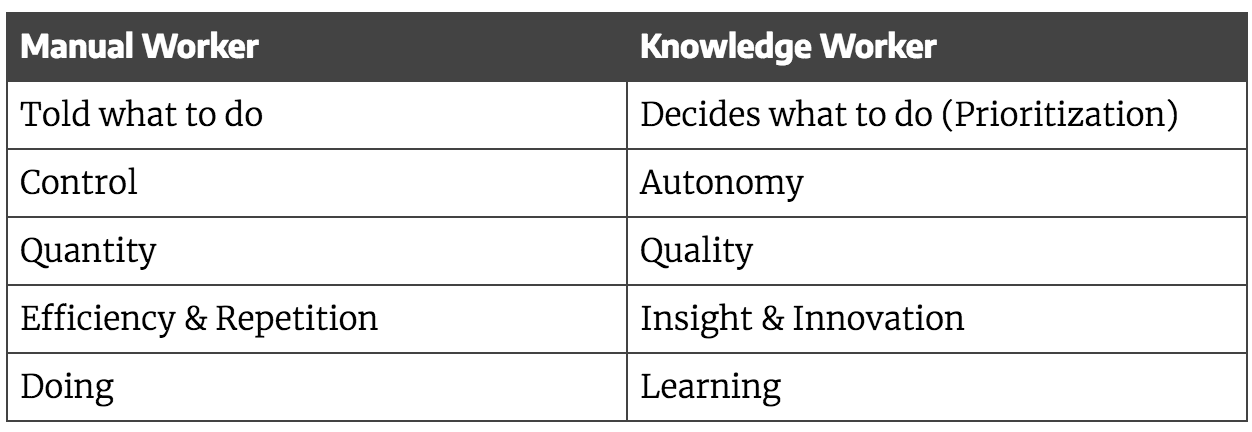
As you advance in your career to higher levels of knowledge work, this process becomes the ultimate way to create value.
Drucker breaks down the difference between quality and quantity in the manifesto:
In most knowledge work, quality is not a minimum and a restraint. Quality is the essence of the output. In judging the performance of a teacher, we do not ask how many students there can be in his or her class. We ask how many students learn anything — and that’s a quality question. In appraising the performance of a medical laboratory, the question of how many tests it can run through its machines is quite secondary to the question of how many test results are valid and reliable.
Productivity of knowledge work therefore has to aim first at obtaining quality — and not minimum quality but optimum if not maximum quality. Only then can one ask: “What is the volume, the quantity of work?
The application of 20th century Statistical Theory to manual work is the ability to cut (though not entirely to eliminate) production that falls below this minimum standard.
This simple difference of optimizing for quality over quantity in one’s work changes the game.
Quantity: Work harder with processes in place to make fewer errors.
Quality: Define what quality is and then create a process that maximizes it.
We see this distinction at play in Warren Buffett’s career. Buffett’s genius is that he prioritizes learning so he can have higher quality insights.
Throughout Buffett’s career, he has only made a handful of investments per year. Describing his approach, Buffett says:
“The trick in investing is just to sit there and watch pitch after pitch go by and wait for the one right in your sweet spot. And if people are yelling, ‘Swing, you bum!,’ ignore them.”
Amazingly,
there have been multi-year periods where Buffett has made zero
investments. Can you imagine how difficult it would be to wake up every
day for years and not invest if you were a professional investor?
Buffett
understands and actually follows through on the logical implications of
what it means to be a knowledge worker in a knowledge society.
Buffett
and the Learner’s Lifestyle converts time into value in a completely
different way than the typical approach to work, which borrows from the
culture of routine, manual work.
Here’s the knowledge work assembly line for the 21st century:

Buffett is not alone in remaking his schedule around insight.
In my previous articles,
I share the stories of many more entrepreneurs and leaders who have
made time for deliberate learning throughout their entire careers. Other
lumineer readers include billionaire entrepreneur Mark Cuban
(three-plus hours a day), billionaire entrepreneur Arthur Blank
(two-plus hours a day), billionaire investor David Rubenstein (six books
a week), billionaire entrepreneur Dan Gilbert (one to two hours a day),
Oprah Winfrey (credits reading for much of her success), Elon Musk (two
books a day when he was younger), Mark Zuckerberg (a book every two
weeks), Jeff Bezos (hundreds of science fiction novels by the time he
was 13), and CEO of Disney, Bob Iger (gets up every morning at 4:30 a.m.
to read).
The
power of the Learner’s Lifestyle has existed for a long time. But, we
are at a unique point in history that is increasing the returns on this
lifestyle.
There’s a famous parable of a consultant that illustrates this perfectly.
The Rise Of The Learner’s Lifestyle
There once was a power plant that shut down because of a mechanical failure. As you can imagine, this was a disaster!
The employees went all hands on deck trying
The employees went all hands on deck trying to fix the problem for days, but no one could find its source.
In desperation, the plant manager reached out to a consultant.
Not
long after, the consultant confidently walked into the plant and spent a
few hours very deliberately walking around to understand each of the
components and how they interacted with each other. He spent several
more hours asking the plant manager and employees a series of questions.
Finally, he went back to a part of the plant he had previously inspected and pressed a button.
Amazingly, the entire plant came back to life. The lights turned on. The machines started whirring. The problem was fixed.
“Oh my god!” the manager exclaimed. “You did it. How much do I owe you?”
“$100,000,” the consultant confidently replied.
“What?! $100,000. All you did is push a button! How do you account for that?”
The consultant pulled out a pencil from behind his ear and grabbed an invoice template from his pocket.
Next, he wrote down the following:
Pushing a button: $1
Knowing which button to push: $99,999
This parable gets at the heart of the power of insight.
In certain situations, having insight can provide 1,000 times the leverage.
We
live in a unique time: Insight is the key to solving more and more
problems, and the dividends on insight are increasing because we live in
an increasingly global, digital, technological, and complex world.
Here’s why there has never been a better time to adopt a Learner’s Lifestyle:
- Globalization leads to larger markets for our insights. Imagine if that same $100,000 insight could then help 1,000 other power plants (customers) across the world. That would effectively increase the value of this one insight a thousandfold. A larger market means that it’s worth spending more time upfront to acquire the insight.
- Digitization means we can scale our insight at no cost. Digitization makes it possible for us to scale ourselves so we can service those 1,000 other power plants without having to travel to each one individually. We can do this through online education. As product categories become increasingly digital via 3D printing, the leverage that comes from insight will get even higher. Harvard professor Yochai Benkler captures the significance of this shift in his book The Wealth Of Networks:
“The removal of the physical constraints on effective information production has made human creativity and the economics of information itself the core structuring facts in the new networked information economy.”
- Technology is increasing our manual work productivity exponentially. Every job includes “doing.” But, we can now can do more in dramatically less time. In other words, the gap between having an idea and realizing it in the physical world is shrinking. Because of this, there is a growing number of “Million-Dollar, One-Person Businesses” (aka incredibly profitable businesses run by just one founder and NO employees), and the largest companies in the world today have fewer employees per dollar of revenue than the previous generation’s.
- Complex problems require deeper levels of cross-disciplinary learning. The most complex problems that individuals, businesses, and society faces are innately cross-disciplinary. People who spend more time learning across fields are at an advantage to have unique insights to solve these problems.
- There are more and more ways to turn insights into value. Some of the ways include: creating new knowledge using the scientific method (science), creating a new paradigm or approach in a field (thought leadership), sharing your existing knowledge (teaching, consulting, coaching), working for a company, starting a company, or using your knowledge to train an artificial intelligence algorithm.
- The world is changing faster and faster. As the environment changes more quickly, it takes more and more adaptation to stay in the same place. This is known is the Red Queen Effect and the Law Of Requisite Variety. Learning, thinking, experimentation, and insight are how we adapt.
Bottom line: We’re
in a time of a lot of technical change. That technical change is
resulting in cultural change — specifically, how we work and
live — which is increasing the return on insight. Hard work is critical
to success. But the scales are tipping toward insight.
This brings me to my next point: the Learner’s Lifestyle is the perfect fit to the ways we live and work now.
Dream Job Alert: Get Paid A 6-Figure Or 7-Figure Salary To Read, Think, And Experiment For Hours A Day From Wherever You Want
Over the last two decades, many professionals have moved away from more traditional work lifestyles:
- Working at one company their whole life
- Working 70-plus hours per week (while subordinating health, learning, family, and friends to career success)
- Keeping a professional front at work (while leaving yourself at the door)
…to the following Lifestyle Design Movements:
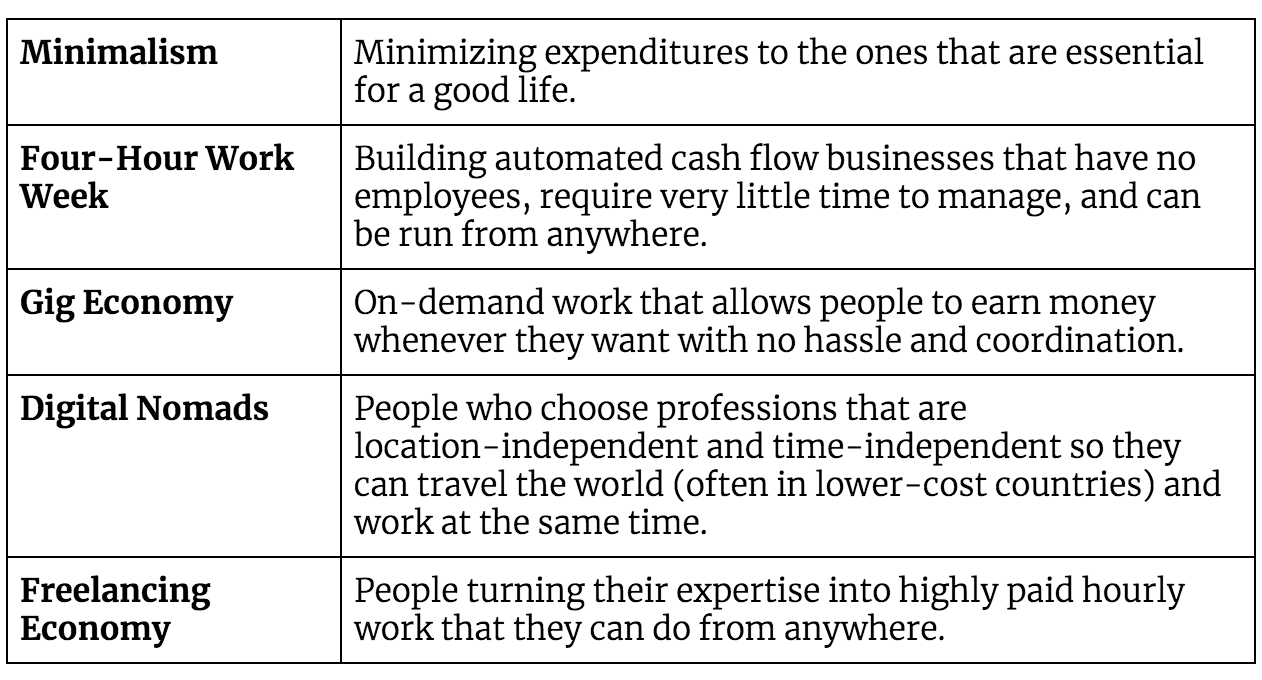
While all of these movements are different, they also have a lot in common. People don’t want to be forced to do:
- Work they don’t want to do
- When they don’t want to do it
- With people they don’t want to be around
- In stifling environments (that’s a repetitive stress injury waiting
to happen)
… just to make barely enough money to feed themselves and their family.
Buffett’s
contribution is a new category of lifestyle design — The Learner’s
Lifestyle. This category of work is particularly well-suited for people
who:
- Are lifelong learners
- Deeply love learning
- Enjoy virtual work
- Appreciate flexibility
- Are long-term thinkers
- Want to get paid for impact rather than time
My only regret is that I wasn’t exposed to this as a life and career path earlier, as I’m perfectly suited for it.
Here’s my journey toward it unfolded…
My Story: From Burned-Out Entrepreneur To The Learning Lifestyle
When
I first heard about Warren Buffett’s Learner’s Lifestyle, my kids were 3
years old and 1 year old. My business required a lot of travel and
meetings. I was working so much it was hurting my health, my
relationship with my wife, and my relationship with my kids. In retrospect, I was burned out.
The
only learning time I had was once the kids were asleep. However, by
that point, my energy was so shot that my routine became:
- Flop on the couch.
- Flip through bad TV options.
- Be disappointed that there was nothing I wanted to watch.
- Watch something completely mind-numbing.
At
the time, my daughter and I were occasionally watching “Hannah
Montana.” I’m embarrassed to say that I watched an episode alone far
more than once.
That was my rock bottom — watching a preteen sitcom by myself and enjoying it.
Today — six
years later — I spend 4–5 hours a day reading and thinking, and I view
it as fundamental to what I do. I have one meeting per day or so. I take
a 1–2 hour break in the middle of the day. When the kids go to bed, I
go for a walk with our dog while listening to audiobooks.
So, how did I go from watching “Hannah Montana” to leading a Learner’s Lifestyle where learning is baked into my day?
Of
course, there were many more detailed steps (which I will go into my
next article), but here are the two key ideas you need to know now so
you can begin the journey or go to the next level.
Two Steps To Kickstart Your Learner’s Lifestyle
There are two steps you can take right now:
Step #1: Put yourself in jobs, professions, companies, and industries where you are valued for your insight.
As
life goes by, we are presented with choices about the people we
collaborate with, the bosses and mentors we learn from, the projects we
take on, and the professions and industries we join.
Each of these choices has a profound impact on our ultimate learning.
At
the extreme end of the spectrum, someone stocking shelves at Wal*Mart
is only going to be valued for their physical effort. Similarly, a
white-collar worker who does the same thing over and over is primarily
going to be valued for their effort and accuracy.
In
the middle of the spectrum, a rapidly-evolving industry is more likely
to appreciate new insights and innovations than one that is changing
slowly.
At
the other end of the spectrum, a long-term value investor like Warren
Buffett can get an incredible return on investment by only making a
handful of big investment decisions per year. Entrepreneurs must rapidly
learn several disciplines in order to succeed and they live and die by
their own decisions.
The pathway that I followed included the following steps:
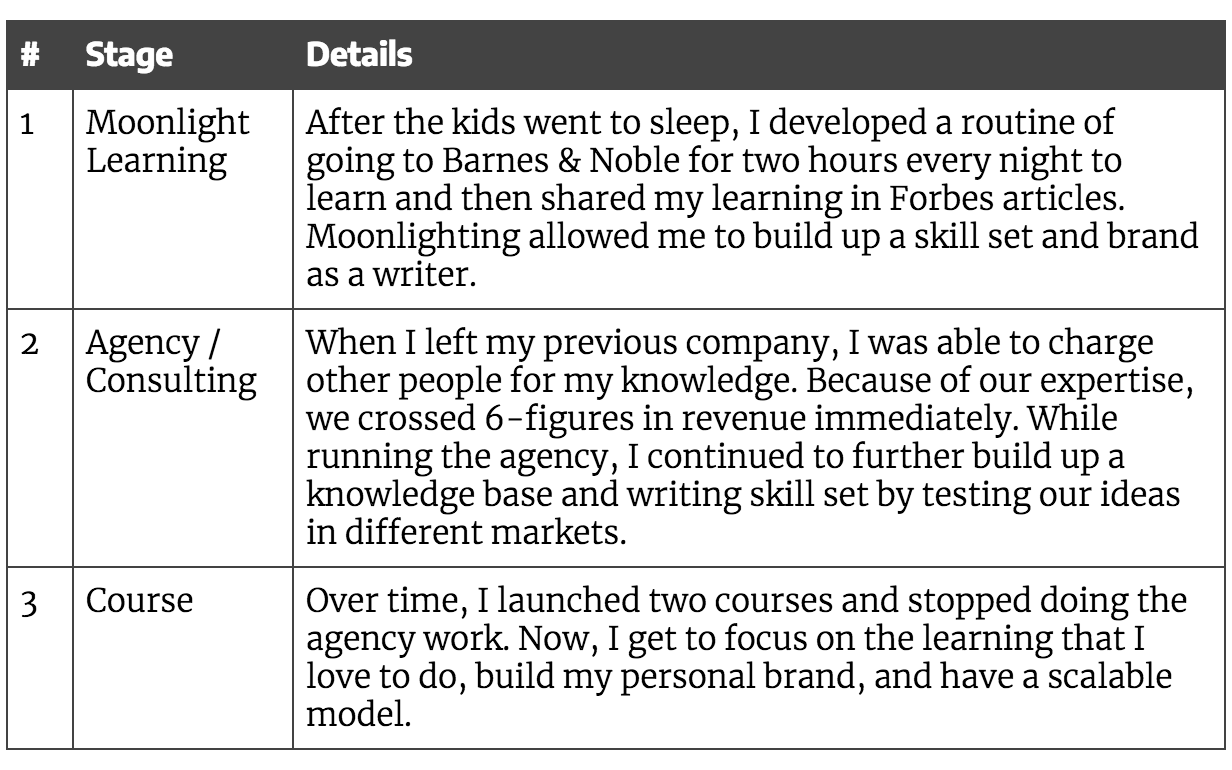
Each stage of the journey was essential to the next.
Step #2: Increase the leverage of your insights.
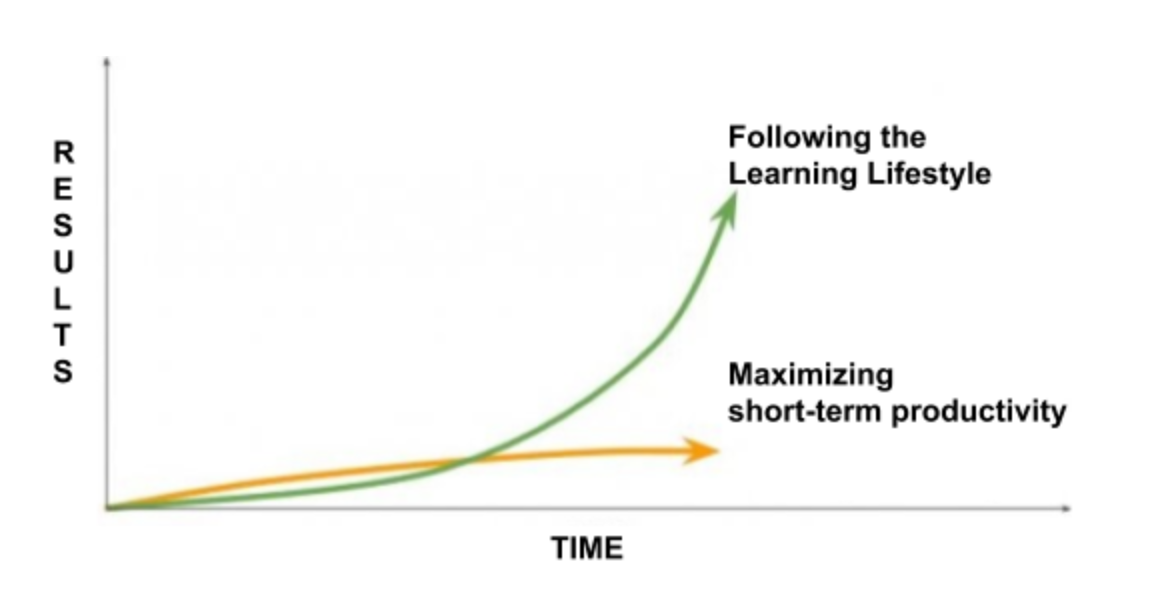
As you improve your learning and thinking ability, the value of your insights multiplies.
To take advantage of this multiplier, you need to put time into learning and learn how to learn more effectively.
This
way, your knowledge will compound upon itself, and over time, your
insights will become your durable competitive advantage in your career.
Start Compounding Your Knowledge Right Now
If
you’re serious about building your own Learner’s Lifestyle, and want to
make learning your competitive advantage, attend my free Learning How
to Learn Webinar. In just 2 hours, you will learn:
- How to find one hour per day for reading and learning even if you are really busy and overwhelmed
- How to 10x the results you receive from each hour of learning, and double them right away with a simple, little-known technique
- How to systematically apply what you learn to increase your profit and income
— — —


Michael Simmons
Learning
How To Learn Speaker & Teacher / Serial Entrepreneur / Bestselling
Author / Forbes, Fortune, Time, HBR Contributor / Site: http://t.co/T32xDLUBLJ

Responses
Applause from Michael Simmons (author)