Change

Adapt, cope, remain flexible and foster a positive attitude amidst life's ups and downs.

Thursday, June 21, 2012

Gurdjieff


What is The Work?
"The Work is for those who are looking for something, who are not satisfied with what they have found in life, and who feel that there must be something else besides success or failure in life, besides what they have been taught at school and college and by their upbringing in general."

— G.I. Gurdjieff —


Uploaded by on Oct 8, 2009
 
A presentation on the teachings of G.I. Gurdjieff and the Fourth Way system of self-awareness and transformation of consciousness.

Additional material on these teachings can be found in the books:
"The Wisdom of the Fourth Way: Origins and Applications of a Perennial Teaching"
and

"The Fourth Way and Esoteric Christianity: An Introduction to the Teachings of G.I. Gurdjieff"   for those who undertake "The Work".

This is the full lecture running 14:40 minutes which was initially available as a three minute clip.

License:

Standard YouTube License

Monday, June 18, 2012

MYNA MOTHER


The week's best photojournalism - The Week


Dance of the red beards

Feed us!

An Indian Myna, with a praying mantis gripped in its beak, prepares to feed its chicks in a nest built inside the wall of an underpass in Greater Noida on the outskirts of New Delhi.
PHOTO: REUTERS/Parivartan Sharma

Saturday, June 16, 2012

Rules to live by

At the start of the new millennium the Dalai Lama issued eighteen rules for living:


1. Take into account that great love and great achievements involve great risk.

2. When you lose, don't lose the lesson.

3. Follow the three Rs: 1. Respect for self 2. Respect for others 3. Responsibility for all your actions.

4. Remember that not getting what you want is sometimes a wonderful stroke of luck.

5. Learn the rules so you know how to break them properly.

6. Don't let a little dispute injure a great friendship.

7. When you realize you've made a mistake, take immediate steps to correct it.

8. Spend some time alone every day.

9. Open your arms to change, but don't let go of your values.

10. Remember that silence is sometimes the best answer.

11. Live a good, honourable life. Then when you get older and think back, you'll be able to enjoy it a second time.

12. A loving atmosphere in your home is the foundation for your life.

13. In disagreements with loved ones, deal only with the current situation. Don't bring up the past.

14. Share your knowledge. It's a way to achieve immortality.

15. Be gentle with the earth.

16. Once a year, go someplace you've never been before.

17. Remember that the best relationship is one in which your love for each other exceeds your need for each other.

18. Judge your success by what you had to give up in order to get it.


Drucker's management classics reviewed


Management: Revised Edition by Peter F. Drucker with Joseph A. Maciariello; Collins, 568 pages, $29.95.


The Five Most Important Questions You Will Ever Ask About Your Organization by Peter F. Drucker, Jim Collins, Philip Kotler, et al.; Leader to Leader Institute/Jossey-Bass, 119 pages, $14.95.


Drucker's Management Classics

By Bruce Rosenstein, USA TODAY

In this era of soaring food and gas prices, lost homes and the virtual overnight collapse of once-powerful companies, a return to fundamentals is in order. 

That's what makes the publication of Peter Drucker's Management: Revised Edition so timely.

It's a revised and updated edition of his 1973 classic Management:
Tasks, Responsibilities, Practices, which is also relevant for non-managers who care about where our institutions are headed and what roles they'll play as their careers inevitably change. 

Joseph Maciariello. — of the Drucker School at Claremont Graduate University, in California — has collaborated on the last several Drucker books.

Drucker considered management to be a blend of action and contemplation. 


The words "think" and "thinking through" appear often.  Managers must take the time to consider what they are doing and just as important, why they are doing it.

Drucker produced a vast body of work, nearly 40 books and countless articles, before he died in 2005 at 95.

Many of his classic themes are on display, including:

•Management by objectives.

 Your organization's strategy for the present and future, converted into targets and assignments in such areas as marketing, innovation, human resources, productivity and social responsibility.

•The theory of the business.
Collectively, it's the assumptions an organization makes about markets, customers, competitors, technology and other factors that make up its reason for being, or as he bluntly puts it, "what a company gets paid for." If your theory is outdated or no longer valid, you're headed for trouble.

•Management revolving around people.

  A manager's job is defined by relationships with colleagues, "upwards, downwards and sideways."

•Information responsibility.

  You must ask yourself what information you need to do your job and where you will find it. Related questions are what information you owe to others and what they owe to you.

•Getting out of the office.
 The key areas affecting your organization will inevitably take place in the outside world. Go out and talk to customers and find out who your non-customers are. Become a volunteer in a non-profit agency, not only for personal growth and helping others, but to work with and learn from people who don't necessarily see things as you do.


Drucker drew super-achievers as followers, such as Jack Welch (retired CEO of General Electric and now a best-selling author), Rick Warren (pastor of Saddleback Church in Lake Forest, Calif., author of The Purpose-Driven Life, one of the best-selling books of all time), and Jim Collins, author of the modern leadership classic Good to Great.

Collins wrote "Peter Drucker's Legacy," the foreword to Management: Revised Edition. He also contributed to The Five Most Important Questions You Will Ever Ask About Your Organization. While you'll want to keep the former (568 pages) on your bookshelf for ready reference, you can keep the latter (at 119 pages) in your briefcase. It may be a slim book, but it's thought-provoking and has the potential for profound impact in your workplace.

It is built around the following self-assessment questions: What is Our Mission? Who Is Our Customer? What Does the Customer Value? What Are Our Results? What is Our Plan?


Drucker's writings about each question are followed by a brief reflection from the likes of Collins, Northwestern University marketing guru Philip Kotler and Leader to Leader Institute Chairman Frances Hesselbein.

Drucker's spirit lives on. His compassion and humor are illustrated in one particular passage from Management: Revised Edition. In describing why people may succeed when given a second chance in a job after failing the first time, he warns they should receive "only one second chance. The person who does not perform twice in a row better go to work for your competition!"


 Source:
 http://www.usatoday.com/money/books/reviews/2008-09-01-drucker_N.htm

Drucker's management classic is back again, updated - USATODAY.com

Friday, June 15, 2012

Drucker


kkkkk


"The Five Most Important Questions You Will Ever Ask Your Organization"

By Peter Drucker


Peter F. Drucker: "The Five Most Important Questions..."


Great Ideas! Peter Dr ucker's "The Five Most Importa


The Five Most Important Questions: You will ever ask your organization.

What is our mission?

Who is our customer?

 What does the customer value?


What are the results?


What is our plan?


 Strategy was his specialty with focus on the role and responsibility of senior management.

He was born in Vienna in 1909, left in 1933 and arrived in the U.S in ’37


 In 1942 he wrote The Concept of the Corporation about GM

 In 1971 he moved to California and helped establish the first Executive MBA program


Strategy was his specialty with a focus on the role -- and responsibility -- of senior management


Drucker published 31 books, which have been translated into more than 20 languages


Peter Drucker died in 2005 at the age of 95, having observed and advised organizations for nearly 75 years


People are the organization’s most valuable resource Management’s job is to prepare and free people to perform.

He put the customer at the center of business strategy.

The Knowledge Worker “Planned abandonment”

Peter Drucker is generally regarded as the godfather of modern management

.................................................


Peter Drucker’s "The Five Most Important Questions You Will Ever Ask Your Organization"


This book offers 5 simple questions :

What is our mission?
Who is our customer?
What does the customer value?
What are our results?
What is our plan? 


People are the organization’s most valuable resource.

Management’s job is to prepare and free people to perform.

He put the customer at the center of business strategy.


Organizations do not fail to achieve their objectives for lack of effort; they work really hard

They lack focus and tool competence to “succeed in a turbulent and exacting environment, organizations must focus on mission, demonstrate accountability and achieve results.”

 “You cannot arrive at the right definition of results without significant input from your customers.”

“The danger is in acting on what you believe satisfies the customer. You will inevitably make wrong assumptions.”


 Question 1 What is our Mission?


“A fundamental responsibility of leadership is to make sure everybody knows the mission, understands it, lives it.”


It’s why you do what you do.  Not how


Opportunities, Competence, Commitment “An exacting match”


“The dynamic interplay between continuity and change”


So what changes? Strategies, tactics, processes, structures, methods


  Very importantly Mission also guides you in what not to do


Question 2 Who is our Customer?


Whoever must be satisfied for the organization to achieve results


Customers are never static:
They will become more diverse
Their needs, wants and aspirations will evolve


Being clear about who the customer is provides the jumping off point for the remaining questions


Customers are often one step ahead of you


 “The purpose of a company is to create a customer.”

  The best companies don’t create customers. They create fans.


Old thinking about customers: They hear about us and, hopefully, choose our products

New thinking: We choose, and refuse, our customers


Our business is not to casually please everyone, but to deeply please our target customers  by the quality of the customer experience.

Success depends on your contribution to the success of your customers.


Question 3 What does the customer Value?


“This question is so complicated and important that it can only be answered by customers themselves.” 


Rule #1  There are no irrational customers.  At least in terms of their own reality and situation

Leaders tend to answer this for themselves Which is often more about the value they want to deliver


So what is it that customers value?


For one thing: An organization that seeks their feedback, is capable of solving their problems and meeting their needs


This may be the most important question ? And the one least often asked


Question 4 What are our Results?   


Think in terms of both Quantitative and Qualitative measures


Make them wide- ranging, relevant and hard to game


A key question: Do we -- or can we -- produce sufficiently outstanding results to justify putting resources in this area?

Can lead to “organized abandonment”

If results are the goal They must also be the test


Question 5 What is our Plan?


“Planning is not masterminding the future.” “In the face of uncertainties, planning defines the particular place you want to be and how you intend to get there.”


Never set more than five goals


Five elements of effective plans:  Abandonment, Concentration, Innovation, Risk Taking, and Analysis


Action steps and a budget should be outcomes of planning


Back to the beginning: Why do a self-assessment?


Simple questions can be profound

Answers are important, but the most important thing is to ask the right questions The ultimate beneficiary should be the customer

There are, however, significant benefits to you and your organization

You will:
Look within yourself and your organization
Accept and respond to customer feedback
Embrace change
Foster innovation
Encourage planned abandonment and
Demand measurable results


Quotes by famous Folks


“Imagination is more important than knowledge”
- Albert Einstein


“To know that we know what we know, and that we do not know what we do not know, that is true knowledge”
- Henry David Thoreau


“Imagination is more important than knowledge. For knowledge is limited to all we now know and understand, while imagination embraces the entire world, and all there ever will be to know and understand”
- Albert Einstein


“The difference between a successful person and others is not a lack of strength, not a lack of knowledge, but rather in a lack of will”
- Vince Lombardi


“Liberty can not be preserved without a general knowledge among the people”
- John Adams


“The greatest obstacle to discovery is not ignorance -- it is the illusion of knowledge”
- Daniel J. Boorstin


American King James Version
For in much wisdom is much grief: and he that increases knowledge increases sorrow.
- Ecclesiastes 1:18


“Three passions simple but overwhelmingly strong, have governed my life; the longing for love, the search for knowledge, and unbearable pity for the suffering of mankind”
- Bertrand Russell


“There is no knowledge that is not power”
- Ralph Waldo Emerson


“Integrity without knowledge is weak and useless, and knowledge without integrity is dangerous and dreadful”
- Samuel Johnson


“The true sign of intelligence is not knowledge but imagination”
- Albert Einstein


“The only source of knowledge is experience”
- Albert Einstein


“It is the supreme art of the teacher to awaken joy in creative expression and knowledge”
- Albert Einstein


“A little knowledge that acts is worth infinitely more than much knowledge that is idle”
- Khalil Gibran


“Where is the wisdom we have lost in knowledge? Where is the knowledge we have lost in information”
- T. S. Eliot


“What we want is to see the child in pursuit of knowledge, and not knowledge in pursuit of the child”
- George Bernard Shaw


“The only good is knowledge and the only evil is ignorance”
- Socrates


“Science is organized knowledge. Wisdom is organized life”
- Emmanuel Kant


“A good decision is based on knowledge and not on numbers”
- Plato


“Knowledge of what is possible is the beginning of happiness”
- George Santayana


“All the knowledge I possess everyone else can acquire, but my heart is all my own”
- Johann Wolfgang von Goethe


“A thorough knowledge of the Bible is worth more than a college education”
- Theodore Roosevelt


“Knowledge is a treasure, but practice is the key to it”
- Thomas Fuller M.D.


“When you know a thing, to hold that you know it; and when you do not know a thing, to allow that you do not know it--this is knowledge”
- Confucius


“A popular Government, without popular information, or the means of acquiring it, is but a Prologue to a Farce or a Tragedy; or, perhaps both. Knowledge will forever govern ignorance: And a people who mean to be their own Governors, must arm themselves with the power which knowledge gives”
- James Madison


“The great end of life is not knowledge but action”
- Thomas Henry Huxley


“If a man empties his purse into his head, no man can take it away from him. An investment in knowledge always pays the best interest”
- Benjamin Franklin


“Knowledge comes, but wisdom lingers”
- Alfred Tennyson


“It is the province of knowledge to speak, and it is the privilege of wisdom to listen”


“A knowledge of the existence of something we cannot penetrate, of the manifestations of the profoundest reason and the most radiant beauty, which are only accessible to our reason in their most elementary forms—it is this knowledge and this emotion that constitute the truly religious attitude; in this sense, and in this alone, I am a deeply religious man”
- Albert Einstein


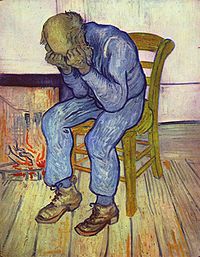
Vincent van Gogh


Vincent van Gogh: "I'd like to show by my work what such an eccentric, such a nobody, has in his heart"


How a genius feels: "I'm a nonentity, an eccentric, an unpleasant person"


March 30th is the birthday of Vincent van Gogh, born in Holland in 1853, a famous painter and also great letter-writer. His letters were lively, engaging, and passionate; they also frequently reflect his struggles with bipolar disorder.

He wrote: "What am I in the eyes of most people — a nonentity, an eccentric, or an unpleasant person — somebody who has no position in society and will never have; in short, the lowest of the low. All right, then — even if that were absolutely true, then I should one day like to show by my work what such an eccentric, such a nobody, has in his heart."

He wrote thousands of letters to his brother Theo over the course of his life. Theo's widow published the van Gogh's letters to her husband in 1913.


Be kind, for everyone you meet is fighting a great battle.
Plato Greek author & philosopher in Athens (427 BC - 347 BC)  


Image source: Vincent van Gogh's 1890 painting At Eternity's Gate. Wikipedia, public domain.


Monday, June 11, 2012

Look to this day


Be Here Now...


Projecting our thoughts far ahead of us, instead of adapting ourselves to the present, is cause of fear. Foresight, the greatest blessing humanity has been given, is also a curse.
~ Seneca, Roman philosopher and politician, Letters to Lucilius


Quotes


Whatever you do, do with all your might. ~ Cicero


When something an affliction happens to you, you either let it defeat you, or you defeat it.
~ Rousseau
 

I have always thought the actions of men the best interpreters of their thoughts. 
~ John Locke 


All things deteriorate in time. ~ Virgil


Each problem that I solved became a rule, which served afterwards to solve other problems. ~ Descartes 


Life is neither good or evil, but only a place for good and evil. ~ Marcus Aurelius 


You forget that the fruits belong to all and that the land belongs to no one. ~ Rousseau


No one is laughable who laughs at himself. ~ Seneca


The energy of the mind is the essence of life. ~ Aristotle


It is not wisdom but Authority that makes a law. ~ Thomas Hobbes


If it is not right do not do it; if it is not true do not say it. ~ Marcus Aurelius


 Republics decline into democracies and democracies degenerate into despotisms. ~ Aristotle


You forget that the fruits belong to all and that the land belongs to no one. ~ Rousseau


The bravest sight in the world is to see a great man struggling against adversity. ~ Seneca


He who does not prevent a crime when he can, encourages it. ~ Seneca

 By a lie, a man... annihilates his dignity as a man. ~ Kant


A man of courage is also full of faith. ~ Cicero 


We have two ears and one mouth so that we can listen twice as much as we speak. 
~ Epictetus 


The countenance is the portrait of the soul, and the eyes mark its intentions. ~ Cicero 


There is no more miserable human being than one in whom nothing is habitual but indecision. ~ William James


You must become an old man in good time if you wish to be an old man long. ~ Marcus Aurelius 


Thursday, May 17, 2012

You are here, this is now, make the best of it.

Imagine every day to be the last of a life surrounded with hopes, cares, anger, and fear. The hours that come unexpectedly will be so much more the grateful.

~ Horace


 "Unless you try to do something beyond
what you have already mastered,
you will never grow."
- Ronald E. Osborn 


The important thing is this: To be able at any moment to sacrifice what we are for what we could become.  
- Charles DuBois


Friday, April 20, 2012

QUOTES ABOUT THE CRAFT OF WRITING


"Successful and unsuccessful people do
not vary greatly in their abilities.
They vary in their desires to
reach their potential."

-- John Maxwell


For a good writer, there is only one measure of success,
and that is found in his honoring the complexity and richness
of his subject while telling his story in a lucid way.

-- Joseph Epstein


The most important sentence in any article is the first one. If it doesn’t induce the reader to proceed to the second sentence, your article is dead. And if the second sentence doesn’t induce him to continue to the third sentence, it’s equally dead. Of such a progression of sentences, each tugging the reader forward until he is hooked, a writer constructs that fateful unit, the “lead.”

-–William Zinsser, On Writing Well, p. 55

Monday, April 9, 2012

EMBRACE CHANGE AND ALBERT SCHWIETZER'S VISION


EMBRACE CHANGE:

"If you cry because the sun has gone out of your life, your tears will prevent you from seeing the stars."
- R. Tagore 
Build a better life according to your ideal Vision.
Do not wait for perfect timing, get started now.
What you do today, is all that matters.
Do your best with what you have and start from where you are.


"Inspiration exists, but it has to find us working." - Picasso


There is power in action so make plans and execute them.

Circumstance is a result of your past and does not indicate where you are heading.

The greatest journey begins with the first step and so does your building of a new business or whatever you are setting out to create.

We all need to start where we are and in the moment, find the strength to overcome obstacles we encounter, persevere and endure until we achieve a few goals and gain momentum in a positive direction.

Live according to your Vision of the well-lived life.


"One who gains strength by overcoming obstacles possesses the only strength which can overcome adversity."
~Albert Schweitzer


Reverence for Life:

Lost in thought I sat on deck of the barge, struggling to find the elementary and universal concept of the ethical that I had not discovered in any philosophy. I covered sheet after sheet with disconnected sentences merely to concentrate on the problem. Two days passed. Late on the third day, at the very moment when, at sunset, we were making our way through a herd of hippopotamuses, there flashed upon my mind, unforeseen and unsought, the phrase : “Ehrfurcht vor dem Leben” (“reverence for life”). The iron door had yielded. The path in the thicket had become visible.”

— Albert Schweitzer


Sunday, April 1, 2012

Vincent van Gogh


Vincent van Gogh: "I'd like to show by my work what such an eccentric, such a nobody, has in his heart"


How a genius feels: "I'm a nonentity, an eccentric, an unpleasant person"


March 30th is the birthday of Vincent van Gogh, born in Holland in 1853, a famous painter and also great letter-writer. His letters were lively, engaging, and passionate; they also frequently reflect his struggles with bipolar disorder.

He wrote: "What am I in the eyes of most people — a nonentity, an eccentric, or an unpleasant person — somebody who has no position in society and will never have; in short, the lowest of the low. All right, then — even if that were absolutely true, then I should one day like to show by my work what such an eccentric, such a nobody, has in his heart."

He wrote thousands of letters to his brother Theo over the course of his life. Theo's widow published the van Gogh's letters to her husband in 1913.


Be kind, for everyone you meet is fighting a great battle.
Plato Greek author & philosopher in Athens (427 BC - 347 BC)  


Image source: Vincent van Gogh's 1890 painting At Eternity's Gate. Wikipedia, public domain.